Anet A8 Plus Reviews: See Why 0 Shoppers Rated It 0 Stars!
Everyone’s got opinions. We collected 0 of them to see if the Anet A8 Plus 3d printer really earns that 0/5 rating.
 Supermod
 Moderator
 Recaptor
Anet A8 Plus Review: A Robust Entry-Level 3D Printer for Beginners and Enthusiasts
The Anet A8 Plus is a strong contender in the budget 3D printer market, designed for a mix of consumer, professional, and educational applications. Released in 2018, this FDM/FFF type 3D printer caters mainly to beginner and intermediate users who want ample build volume combined with decent precision and upgradeability. Based on its engineering data, the A8 Plus stands out for its considerable build size and modular design, appealing to those who enjoy tinkering and customization. But does it really live up to its numbers and justify its price point? Let's dive into the detailed specifications and expected performance to find out.
Detailed Specs & Features
On paper, the Anet A8 Plus offers a workspace of 11.81 inches wide, 11.81 inches deep, and 13.78 inches tall, translating to a generous build volume of 25,152 cubic centimeters. This makes it ideal for printing larger models or multiple smaller parts in batches. The printer operates within an environmental range of 59 to 86°F, ensuring stable performance under standard room temperatures commonly found in homes or classrooms. It supports standard filaments like PLA, ABS, TPU, and HIPS with a filament diameter of 1.75 mm, plus compatibility with third-party materials, enhancing versatility.
The printer features a single direct drive extruder with a nozzle diameter of 0.4 mm (with optional nozzles ranging from 0.2 mm to 0.8 mm), capable of heating up to 482°F. This is notably high and supports a wider range of filament types, including some higher temperature-resistant materials. The build plate can be heated up to 100°F, improving adhesion, particularly for ABS prints, and reducing warping. However, the printer lacks a heated chamber and auto-bed leveling, requiring manual calibration, which might impact ease of use for novices.
Power-wise, the Anet A8 Plus uses an internal power supply supporting a voltage range between 110 and 220 volts, consuming about 270 watts during active printing and 20 watts at idle. It does not include energy-saving modes, suggesting continuous power usage during operation. Safety certifications include CE, FCC, and RoHS, indicating compliance with standard electrical safety and environmental requirements.
Design & Build
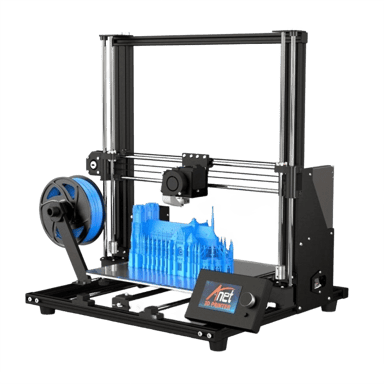
The printer's Cartesian frame and open enclosure design reveal a traditional layout focused on accessibility and ease of modifications. Measuring approximately 22 inches in width, 23 inches in depth, and 24 inches in height, it requires a moderate footprint of 2.5 square feet, manageable for desktop or small workshop setups.
The build plate is dual-material glass and metal with a smooth surface texture and is removable, which simplifies part removal and cleaning. However, the setup necessitates manual bed leveling, demanding users to calibrate with some precision manually to maintain print quality. The presence of a filament runout sensor and power loss recovery functions contributes strongly to reducing failed prints, reassuring users in environments where interruptions might occur.
Performance
If we look at the numbers alone, the Anet A8 Plus supports an official max print speed of 120 mm/s, with a layer resolution that ranges from 100 to 300 microns. This places it solidly in the realm of achieving both rapid prototyping and reasonable surface finish quality for most hobbyists and educational purposes. The print accuracy metric of 100 microns suggests it can deliver fine detail suitable for intricate models.
Notably, the printer does not include spaghetti or fault detection, nor an automatic bed leveling system. This means that users must maintain vigilant manual oversight during prints. The inclusion of print recovery for resuming prints after interruptions is a practical feature that contributes to reliability. Cooling fans help with print quality, and the direct drive extruder contributes to consistent filament feeding, favoring flexible or specialty filaments such as TPU.
Camera & Display
The Anet A8 Plus features a modest 3.5-inch touchscreen display, improving navigation over button-based controls but not reaching the more intuitive interfaces of higher-end models. There is no built-in camera or lighting inside the chamber, limiting remote monitoring or illumination during printing, which is something power users or professionals might miss. Also, no noise levels were specified, leaving it an open question for those sensitive to printer sound output.
Extra Features
Upgrade options exist for adding an enclosure or camera module, reflecting the printer's design flexibility. The absence of advanced features like remote monitoring, cloud-based control, or multi-material printing emphasizes its positioning as a budget-friendly, hands-on printer rather than a fully automated or professional-grade machine. Nonetheless, its open-source capabilities and third-party material support enhance its appeal to makers who want to expand functionality over time.
Pros & Cons
Pros
- Large build volume suitable for sizable or multiple prints
- High maximum extruder temperature allows diverse filament compatibility
- Power loss recovery and filament runout sensor reduce print failures
- Competitive price point with upgrade pathways available
Cons
- Requires manual bed leveling, which can be challenging for beginners
- Lacks several modern convenience features like auto-bed leveling or remote monitoring
- No energy-saving mode, leading to continuous power consumption during use
- The open frame design lacks enclosure, affecting heat retention and noise
Price & Value for Money
At a retail price of $345.22 at Amazon.com, the Anet A8 Plus offers substantial hardware for budget-conscious consumers. Given its 1-year warranty period and powerful 110-220 volt power supply, the pricing feels justified for early adopters willing to engage with assembly and calibration. Hobbyists who value large print volumes without stepping into premium pricing tiers will find this model especially attractive. Conversely, users seeking plug-and-play convenience or advanced automation might want to look elsewhere or consider adding upgrades.
Quick Take
In short, the Anet A8 Plus packs a punch in build size and filament versatility with reasonable power consumption and some fail-safes. If we look at the numbers alone, it's a solid value print machine for those comfortable with manual setup and maintenance. Its strengths in customization and affordability make it a noteworthy option in the entry to intermediate 3D printer landscape.
Closing Recommendation
The Anet A8 Plus appears to perform best for makers, educators, and hobbyists who enjoy a hands-on experience and don't mind manual calibration. It helps users achieve sizable prints with a broad material range while maintaining a respectful price point. However, users looking for a turnkey experience with automatic leveling or smart connectivity may find the learning curve and lack of modern conveniences limiting.
Verdict
Rating: Based on the specifications and overall feature set, we believe Anet A8 Plus deserves 4.1 out of 5.
- Winner Feature => generous build volume and high extruder temperature range supporting multiple filament types.
- Needs Improvement => manual bed leveling and the absence of advanced usability features limit beginner-friendly appeal.
Reviews 0
The good, the bad, and the brutally honest.Average Rating

More 3D Printers 453
Unlock more awesome finds.